
The guardrails aren't the problem
Banks think consumer AI is a timing problem. It's a scope problem, and we learned that the hard way.

We tested our AI money coach with a bank's customers. Most of them didn't want to talk to it.
The maths worked. A woman saving for an emergency buffer said it told her "exactly how short you are." Then she agreed to the plan, and the coach stopped to tell her it couldn't recommend a product. "Bit of a weird buffer," she said.
Others never got that far. A retired teacher saw the word "AI" and wanted nothing to do with it. A tech worker, asked how much he could save each month, replied: "If I can answer that question, how much advice do I need?"
On paper the coach was focused: it helped people build a savings plan. In practice it was shallow. It asked questions, added caveats and handed the hard part back, so it felt like an FAQ with a typing indicator. I suspect that's what most banks are building right now. The technology wasn't the problem. We were pulling the wrong lever.
We've seen this before
When smartphones arrived, most banks shrank their website onto a phone: same menus, smaller screen. It was safe, and nobody loved it. What changed banking were the things only a phone could do, like photographing a cheque to pay it in, or getting a notification the second you spend.
Most bank chatbots today are the mobile website of 2010. They take the FAQ and the call centre script and pour them into a chat box.
Customers have already moved
Four in ten British adults have used ChatGPT or similar tools for money advice, rising to 65% of Gen Z (Finder). The answers are fluent, instant and free, and some of them are wrong. When Which? asked AI tools how to invest a £25,000 ISA allowance (the real limit is £20,000), ChatGPT and Copilot gave the advice anyway (Which?).
And it's moving past answers. Instinct, an AI agent that lives in WhatsApp and iMessage, already books, buys and cancels things on people's behalf, and it's reportedly valued at around $10 billion while still invite-only (enter.co). No app to download, no bank in the loop.
The conversation about people's money is already happening. Just not with their bank.
This is a real innovator's dilemma
Fewer than 9% of UK adults got regulated financial advice last year, while around 13 million have low financial resilience (FCA Financial Lives). The industry has rationally left that group alone, because helping them one to one is expensive and risky. Now a cheaper, rougher product serves them for free. That's how disruption starts.
So every bank I speak to feels squeezed. Move too fast and a bot gets things wrong with your logo on it. Move too late and someone else owns the relationship.
Banks are pulling the wrong lever
Faced with that, banks reach for speed. Some don't launch at all. Some put AI in the back office, where customers never see it. Some launch an open chatbot and restrain it everywhere, which is what we did.
All three treat this as fast versus slow. The real questions are how much you ask the AI to do, and how far it goes.
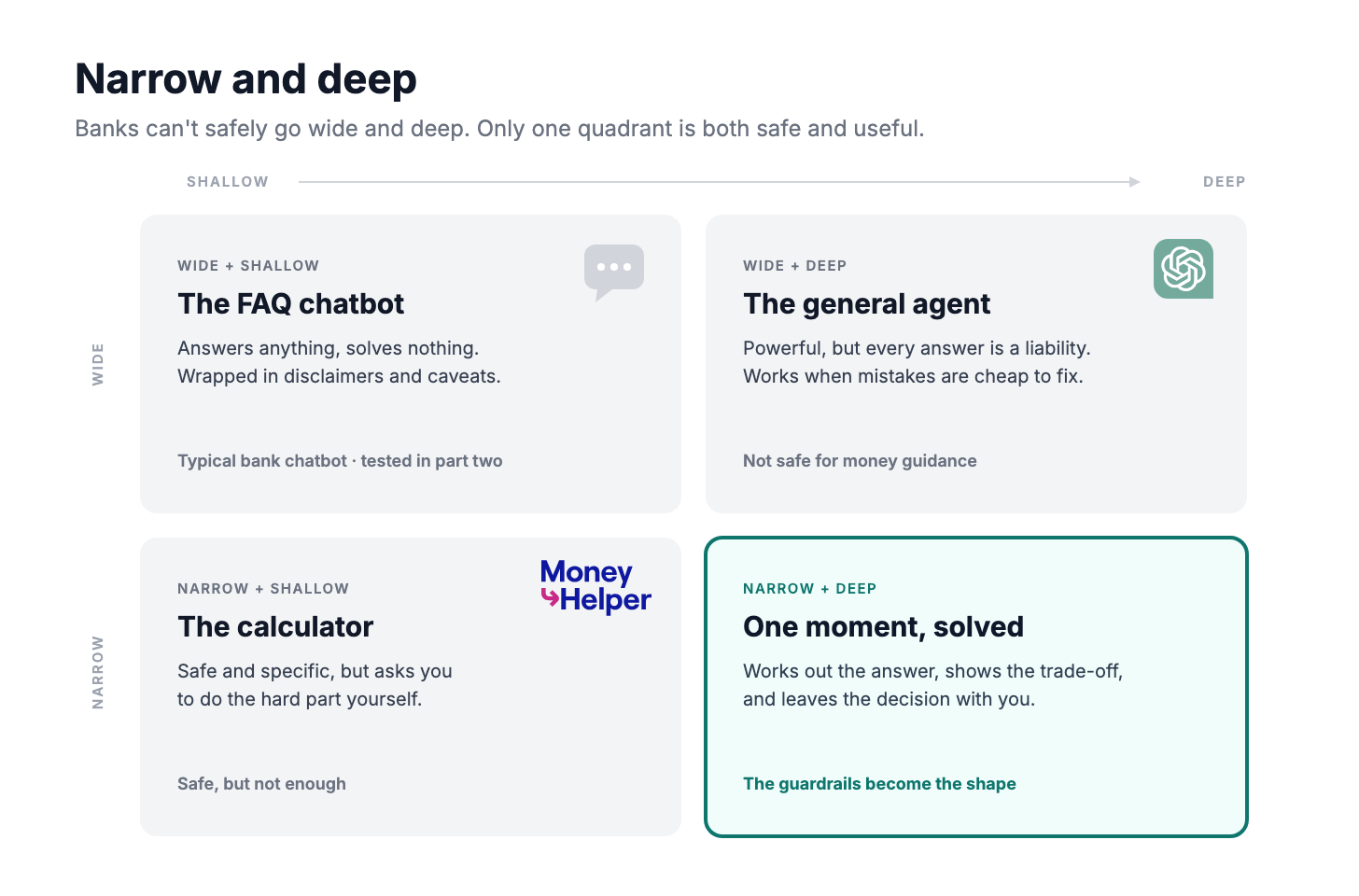
A wide AI, a box that can answer anything, has to move slowly, because every possible answer is a liability. So you add a disclaimer, then a warning footer, then a refusal script, and each one removes a reason to use it.
But narrow isn't enough on its own. Our coach was narrow, and it was also shallow. It took 7 to 9 turns to reach a plan, almost everyone flagged the disclaimer as an interruption, and it kept asking people for the one thing they needed help with. Narrow and shallow is safe, and nobody cares.
Banks can't safely go wide and deep. Wide and shallow is, I think, what most are building. The only option that's both safe and useful is narrow and deep: one moment, solved all the way. Get that right and the guardrails stop being a cage. They become the shape of the product.
Narrow and deep means three jobs
The test: use AI only where the customer is genuinely better off, and where AI is the only practical way to do that for millions of people. Three jobs pass.
1. Show the trade-off. Don't ask people what they can afford. Work it out, and play their own numbers forward. What happens to the buffer if you save every payday instead of monthly? What does the holiday cost in months of emergency fund? That's not a recommendation. It's the consequence made visible, and the decision stays with the customer. It was the part of our pilot that worked for everyone.
2. Notice what's off. A well-timed nudge beats a dashboard nobody opens. When UK banks automatically signed customers up to text alerts, unarranged overdraft charges fell by a quarter (FCA). In the US, Bank of America's Erica reached 20.6 million users last year (BofA) by doing specific things well, not by chatting about anything.
3. Fit it to the person. The people we tested with were paid fortnightly, saving for headphones, or retired and comfortable. ChatGPT gives them all the same answer. The bank knows the product, the pay cycle and the history, and a general model can't copy that.
Disclose it, don't brand it
So we changed the product. We removed "AI" from every label, so the coach is now "Ask" plus the bank's name. The chat takes two turns, then hands you a plan you can edit. And every number comes from a calculator, never the language model, because both wrong figures in the pilot came from generated text.
This isn't hiding anything. The EU AI Act now requires chatbots to tell people they're talking to AI (Cooley), and that's right. Customers should know what's answering them. They just shouldn't have to sign up to "AI" as a relationship.
Trust doesn't come from accuracy. It comes from the institution, and from what you can see. In our pilot, trust in the bank didn't transfer to anything labelled AI, and every complaint the tech worker made was about something hidden: what the bot knew, what it was doing, where the numbers came from. Show the working, keep a human one tap away, and let the bank's name do its job.
Targeted support has the right spirit
The FCA's targeted support regime, live since April, deserves credit for accepting that the old choice between no advice and full advice leaves most people with nothing. But it covers pensions and investments only, through ready-made suggestions for groups of similar customers (FCA).
The moments where finances actually go wrong, like the buffer that never gets built or the overdraft that becomes a habit, sit outside it. And "people like you" is a segment, not a circumstance. The bigger opportunity is information shaped to one person's real numbers, with the decision left to them. That's narrower and safer than advice, not wider.
Where I might be wrong
People want to be known, not watched. Most people assumed the coach could see their real accounts, and that was the expectation we most failed to meet. Yet the tech worker wouldn't upload his transactions to an AI, and another wanted to "opt in with your information rather than ask permission to look at everything." Under UK GDPR, inferring something like vulnerability from spending and acting on it can make that inference special category data (ICO). Nudges have to be opt-in, explained, and on the customer's side.
Personal can be too personal. One participant warned that content built around your own figures can make people anxious.
Narrow products still get used for things they weren't built for. The retired teacher pointed out that someone in a controlling relationship might type into that box asking for help. Every narrow product needs a safe exit for the conversation it wasn't designed for.
Back-office AI is sometimes the right call. And the warning runs both ways. Klarna said its AI did the work of 700 agents, then its CEO admitted quality had dropped and brought humans back (Entrepreneur). That's going wide too fast.
The broad agents might win anyway. Instinct is the strongest case against everything above: broad, and for its early users apparently useful. But look at why it works. Every task ends in something you can check. The flight is booked or it isn't, and if it's wrong, you fix it. Money guidance doesn't work like that. Someone receiving a confident wrong answer about their debt usually can't tell it's wrong, and for a bank it's a conduct breach. Breadth works when every answer ends in an action the customer can verify. Until money guidance does, banks have to go narrow and deep.
The banks that won mobile didn't build the best mobile website. They built things that only worked on a phone.
The same will be true here. The winners won't have the best chatbot. They'll have found the handful of moments where only AI can help, and gone all the way on them, so well that nobody wonders what's powering them.
I've made a claim in this post that I haven't proven yet: that most bank assistants sit in the wide and shallow corner. So I'm going to test it. In my next post, I'll put the major banks' assistants through the same money questions and show where each one actually lands on this grid.
In the meantime, if you're building this inside a bank, I'd genuinely like to know: where did your guardrails make the experience worse, and what did you do about it?