
Are banks becoming the plumbing?
Embedded lending lets a bank grow while the customer's relationship develops somewhere else. A look at what that means for commercial lenders.

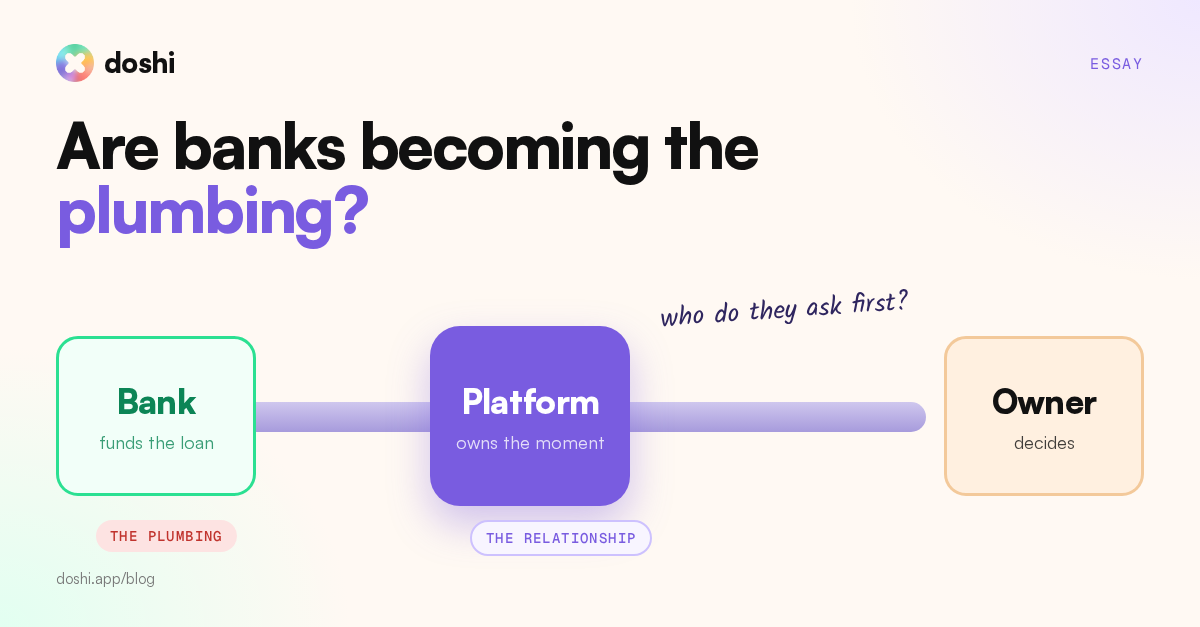
Imagine a restaurant owner on a Tuesday afternoon, looking at a lending offer through Toast. There's equipment they'd like to replace, but they're still working out whether they can afford it. The company they already use to run part of the business is now part of that decision.
A bank might be behind the scenes. The owner might know its name. I'm less sure they would think of it as the place to go when they next need to talk through a problem.
This is a hypothetical scene, not a customer interview. It captures something I'm worried about, though.
I think customers already treat many banks as utilities, and embedded lending makes that position more explicit. The bank can remain important to the transaction while becoming less important to the customer's understanding of their business. For a commercial lender, that seems worth separating from the question of whether the loan book is growing.
A note on where this comes from. I'm writing from the UK, and my own experience (the High Street, building societies, Octopus, Monzo) is UK. The numbers below are a mix of UK and US, and I've labelled each one. They measure different things over different years, so please don't read them as one study.
What I mean by a utility
I'm not claiming banks should become utilities. Nor am I making a legal argument about how they're regulated.
I'm talking about observed behaviour. When I choose an energy provider, I weigh up the cost and how convenient it is to deal with. Additional benefits enter the calculation too. I get a free cinema ticket through Octopus Energy, and I find its app convenient. It may not be the cheapest, but it works well for me.
Banking can enter much the same calculation. I want a better return on savings, or a lower borrowing cost. I want the account to be easy to use. A monthly package of perks adds another variable.
That doesn't make the perks worthless. I just don't think they necessarily recreate the relationship someone had with a person in their High Street branch. I can value a benefit while continuing to shop around.
The customer doesn't have to call their bank a utility for this description to be useful. They may never think about the word.
The platform is already in the business
My reading of Shopify Capital and Toast Capital is that the relationship with the store or restaurant gives them a position a lender would find difficult to reproduce.
They have data that can help them work out who to lend to and how much. The bank can be behind the scenes, supporting something the business experiences through the platform.
I don't mean that platform data tells you everything about a borrower. It won't. But the platform already has a reason to be present in the business, before the owner decides they need finance.
A bank can grow its lending through a platform while the customer's relationship develops somewhere else.
That arrangement might be commercially attractive. I'd still want the lending team and the customer experience team to have the same understanding of what it means. They may be measuring quite different things.
Convenience carried some of the relationship
I think something similar happened when banking moved from the High Street to the phone.
The branch was a convenient place to do your banking, historically. Knowing the people there was partly a secondary effect of visiting. Once the convenient channel changed, there was less reason to have those encounters.
I don't think the trust necessarily moved with it.
There's institutional trust: will my money be safe, will the technology work, can I trust the bank with my data? Then there's what I've been calling micro trust. How much can I share with this person? Can I admit that I don't understand something, or that the business is struggling?
The movement away from established providers is visible in the UK. The big four's share of personal current accounts, counted by number of accounts, fell from 68% in 2018 to 64% in 2021 (FCA strategic review, 2022, Figure 2.1). That doesn't establish my explanation for it. It does make me cautious about assuming an existing account means an enduring relationship.
My answer isn't to rebuild the branch network. The convenience that brought people through the door has changed.
Scale complicates the argument
I initially put too much weight on the idea that relationship-led institutions weren't growing. The US evidence made that difficult.
In the US, between June 2016 and June 2026, credit union membership grew by 38.8%. Their shares and deposits grew by 100.2%, compared with 65.4% growth in bank deposits (NCUA 5300 call reports, June 2016 and June 2026; FFIEC call reports).
There's concentration within that US growth. The four largest credit unions increased their share of all members from 10.3% to 15.7% over the same period (same NCUA data).
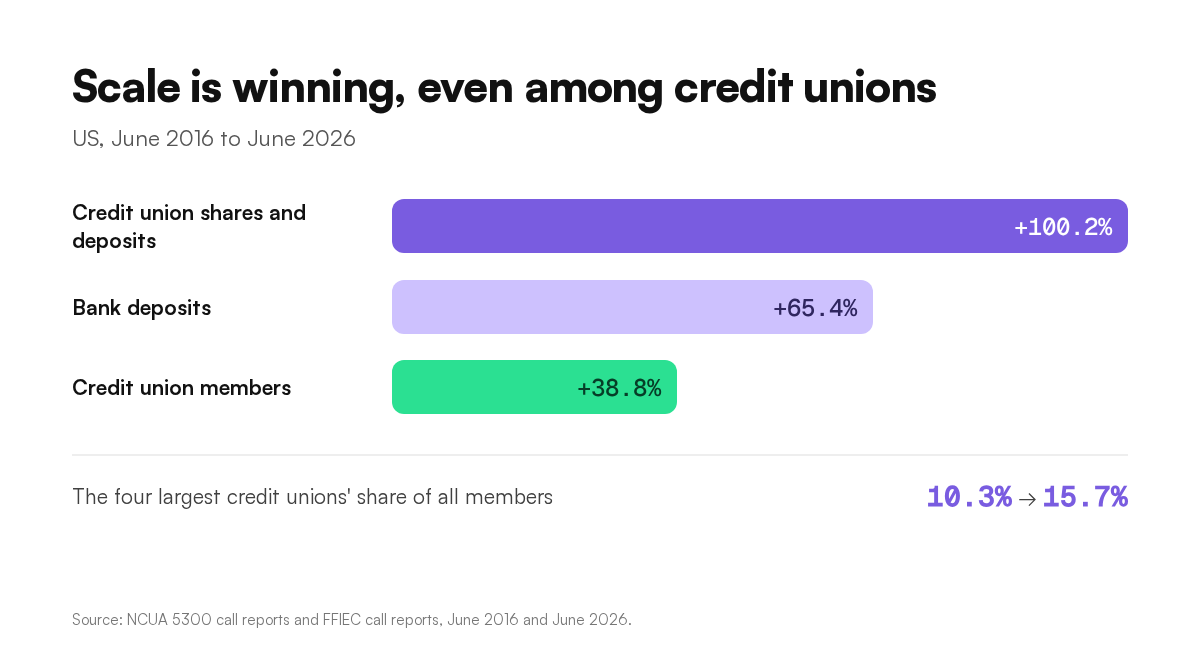
So my narrower view is that scale is winning in important parts of the market. Scale can buy institutional confidence and a more convenient experience. I suspect it also makes the individual relationship harder to maintain, although these figures don't measure that.
That is a US result. For the UK I only have the FCA current-account figure above, which shows share moving from the big four to challengers rather than to the largest incumbents. I don't yet have UK credit union or building society numbers, so my sense that many of them are struggling is an impression, not a finding.
I'm still asking whether an institution such as Navy Federal or Nationwide preserves that personal relationship, or offers a sense of identity and mutuality at scale. I don't have an answer yet.
A better app may leave the harder question open
When I look at Monzo and Revolut, I see a pulling force around convenience and brand. My impression is that they don't need to offer the best rate to attract people.
The UK current-account figures above also complicate any simple story about the biggest incumbents taking everything. Share moved away from the established big four. Scale alone isn't a sufficient explanation.
For a smaller institution, catching up digitally is still necessary. It can consume so much effort that there's little room left to think about what follows.
But I'd want to ask what happens after the app works properly. Does the business owner have a reason to bring an uncertain decision to the bank? Or does the bank become easier to use for a transaction they've already decided on elsewhere?
I build AI for banks, so I'm also asking whether it can help rebuild some of that individual trust. I'm very uncertain about this. Customers may start with considerable distrust of AI, and competent conduct would have to include helping them find questions they hadn't thought to ask. I haven't established that this recreates what was lost.
Where I might be wrong
My original credit union test failed. I said that relationship-led credit unions growing faster than banks would challenge the thesis. In the US, they did. Concentration makes the result more complicated, but it doesn't let me quietly discard the test. Growth at large credit unions might show that relationship and identity can survive scale.
Advice may be different from familiarity. Knowing someone at the branch and receiving useful advice aren't interchangeable. A business owner may rarely contact their bank and still value it enormously when a difficult decision comes up. Account activity would be a poor way to measure that.
Expectations could come full circle. People might become tired of impersonal digital services and place more value on continuity. I don't think institutions should plan on that happening, but I could be underestimating it.
I may be watching the wrong challengers. Monzo and Revolut could themselves be overtaken. Crypto could change the landscape enough that this comparison becomes less useful. That's a separate argument, and I'm not confident about its direction.
Agents are another possibility. If they manage more of our money, institutions may need to serve their requirements as much as human preferences. My convenience argument assumes a person is choosing the interface.
New institutions could change the pattern. In the US, the latest year (June 2025 to June 2026) shows 10 new bank charters against 190 that disappeared, though "new" includes conversions and reorganisations (FFIEC call reports). That currently supports consolidation. A sustained change in the balance would weaken the argument, and the UK needs its own evidence rather than a borrowed US conclusion.
Back at that restaurant on Tuesday, the owner might take the offer through Toast and feel well served. There may be no customer problem to fix.
The bank still needs to understand its position. It might deliberately choose to provide lending behind the scenes. If it expects that lending to produce a direct relationship, I'd want to see evidence that the owner subsequently comes to it for help. A name in the paperwork wouldn't settle that for me.
So here's what I'd like to know. If you run lending or customer experience at a bank, credit union or building society: when a business customer has a decision they haven't worked out yet, who do they ask first, you or the platform they run the business on? Tell me in the comments, and say which country you're in, because I suspect the answer differs between the UK and the US.